Courtroom
The RoomThe Courtroom is the setting where the Unnamed protagonist’s distrust of the justice system takes concrete form: first in a preliminary hearing he can barely follow, and later in a projected trial where he imagines confronting the prosecution himself. The contrast between formal procedure and his experience of confusion and exclusion makes the room more than a legal venue. It is where the authority he fears is exercised—and where he tries to imagine turning its rules against it.
Definition and Setting
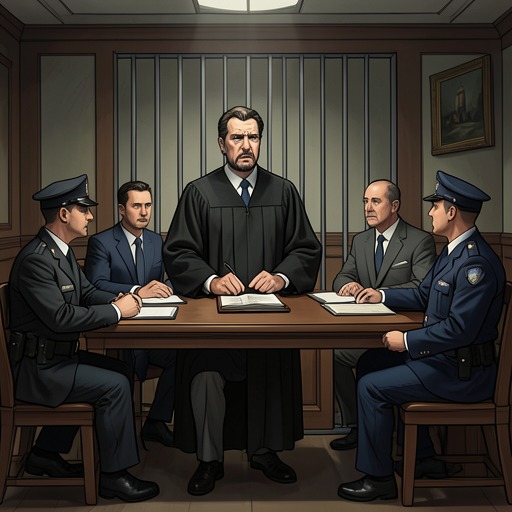
The Courtroom is presented through what happens there rather than through a physical description. The narrative gives the room its character through a sequence of formal actions: charges are read, attorneys cite cases, motions are argued, testimony is questioned, objections are sustained, and the court issues directions. Against this procedural order, the Unnamed protagonist registers little sense of control. He stands, sits, listens, waits, and tries to understand what the proceedings require of him.
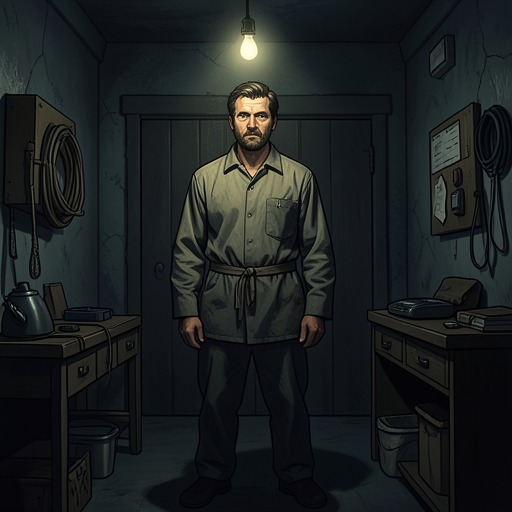
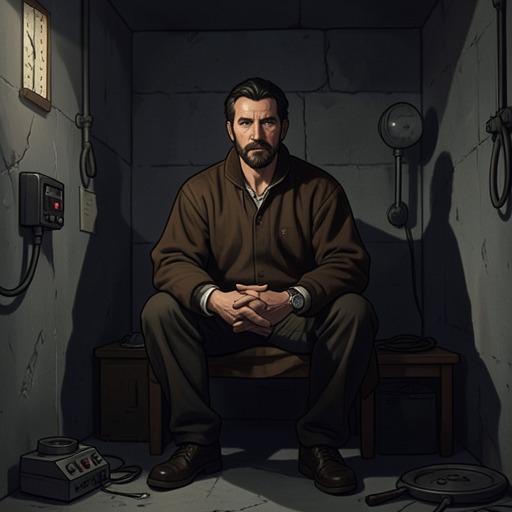
The courtroom is also one stop in an exhausting chain of confinement and transport. On the day of the preliminary hearing, the Unnamed protagonist is taken from his cell through a series of holding areas, chained for the bus journey, brought to the courthouse, and eventually returned to the jail. He later recalls being awakened at about 5:30 and getting back to his cell after 7:30, while describing the entire ordeal as fourteen hours. The trip’s repeated waits and transfers surround the courtroom with the machinery of custody; the hearing is not an isolated encounter but a part of a day organized by detention.
The Preliminary Hearing
When the charges are read, the Unnamed protagonist recognizes a few words, but the legal language otherwise sounds to him like a foreign tongue. He hears the sounds without being able to follow their meaning. Asked for his plea, he answers not guilty. The public defender beside him gives him paper and a pencil and instructs him to write down questions rather than interrupt testimony, explaining that he cannot listen to the witnesses and speak with the defendant at the same time. The Unnamed protagonist accepts the materials silently, unsure of the lawyer’s name and convinced that the unfamiliar man has already abandoned him.
At first, he tries to make himself useful as a listener. He holds the pencil ready, hoping to catch discrepancies in the arresting officers’ testimony and give his lawyer grounds to challenge the prosecution. But he cannot put what he notices into words. As the hearing continues, his frustration grows; the pencil ends up lying on the paper while the lawyers make stipulations, waive matters, and cite cases. His attention is present but increasingly ineffective: the process continues around him without becoming intelligible or answerable to him.
The public defender moves to dismiss the case on several grounds, and the prosecuting attorney argues against dismissal. After a recess, the judge refers to the attorneys’ citations, adds citations of his own, and denies the motion. The Unnamed protagonist experiences what follows as a succession of questions and answers while his lawyer fails, in his view, to challenge what is happening. His anger is directed not only at the ruling but at the apparent gap between having a representative in the room and receiving meaningful representation. When the hearing ends, he is led away without feeling that he understood or influenced it.
The Imagined Trial and Its Procedures
A later courtroom sequence grows out of the Unnamed protagonist’s resolve to make his turn in court count. He imagines forcing the prosecution to proceed to a jury verdict of not guilty, rather than letting the charges be dismissed and potentially brought again. His imagined strategy turns legal procedure into both a defense and a means of retaliation: he wants to make the opposing lawyers struggle, but he also insists that the case reach a verdict so that the principle of double jeopardy will protect him.
In this projected trial, questioning fixes on specific details of an alleged incident. The witness says he was traveling north as he approached the intersection, was in the front seat, and was driving approximately twenty-five miles per hour. The questions press over ground that the prosecutor says has already been covered. The prosecutor objects to asking the same question in six different ways, and the court sustains the objection, ruling that repetition is unnecessary. The scene presents questioning as a contest over who may determine which details deserve further scrutiny.
The imagined defendant also asks about lights in a store window. The prosecutor responds that the Department of Water and Power has testified that the streetlights were burning, that the burglar-alarm company established the window lights were on, and that the United States Weather Bureau supplied a report. The prosecutor calls further questions superfluous, and the court agrees that this line of inquiry is unreasonable and unnecessary. The weight of expert and institutional testimony closes off the defendant’s attempt to pursue the point.
The judge then reminds the Unnamed protagonist that he insisted on acting as his own defense counsel despite the court’s contrary advice and the availability of a public defender. The judge offers representation for the remainder of the trial once more. The defendant declines, and the judge warns that proper trial procedures must be followed or he will be held in contempt. The exchange makes self-representation double-edged: it is a choice the defendant asserts, but it does not free him from the court’s power to define and enforce the rules of participation.
Institutional Meaning and Narrative Role
The courtroom scenes echo the Unnamed protagonist’s wider claim that the police exercise power through rules ordinary people cannot know or avoid. He argues that outdated laws, including a prohibition on spitting on the sidewalk, give police opportunities to harass citizens and retaliate over real or imagined grievances. The Courtroom appears downstream of that claim: a place where the legitimacy of enforcement might be tested, but where the protagonist feels that formal proceedings reproduce rather than correct the imbalance.
His later interior account broadens the grievance from one hearing to unequal access to defense. He imagines poor defendants jailed over minor thefts while wealthy defendants can afford teams of lawyers, and doubts that a prestigious lawyer such as Stacey Lowry would take a case like his. These are the protagonist’s accusations and expectations, not independent findings established by the courtroom scenes. Their importance lies in how they shape his reading of procedure: every objection, restriction, and denial becomes evidence to him that the system is arranged against people without money or influence.
The narrative therefore holds actual procedure beside an imagined courtroom campaign. In the preliminary hearing, the Unnamed protagonist is confused, mostly silent, and unable to make his notes into an effective challenge; in the later scene, he imagines himself directing questions and forcing the case toward a jury. Yet the imagined trial also reproduces limits: the prosecutor objects, the judge sustains the objection, and the defendant is warned about contempt. The Courtroom becomes the setting for both his hoped-for agency and his fear that the institution can always define the boundaries of that agency.